The job we spent twenty years hiring for is the one AI is best at.
For most of my career, the path was to go narrow. You became the React person, or the database person, or the one who owned the payments service and nothing else. Depth was the whole game, and a deep specialist was worth a lot.
AI is quietly erasing the value of that. The narrow, execution-only slice of the job is exactly the part a model does well now. So the question I've been wrestling with isn't whether to upskill developers. It's upskill them into what, when the thing they were great at is the thing getting automated.
We have around 300 software engineers at Full Scale. Figuring out how to move that many people in a new direction at once has been one of the hardest problems I've worked on, and most of what I assumed going in turned out to be wrong.
"Broad" doesn't mean knowing more languages
When people hear "broad developer" they think full-stack, like it's a checklist of frameworks. That's not it.
The broad developer I want owns the whole loop. They understand the actual problem, define the requirements, do the solution architecture, implement it, test it, deploy it, and then go get feedback and start over. They own the process of turning a fuzzy business need into working software that real people use.
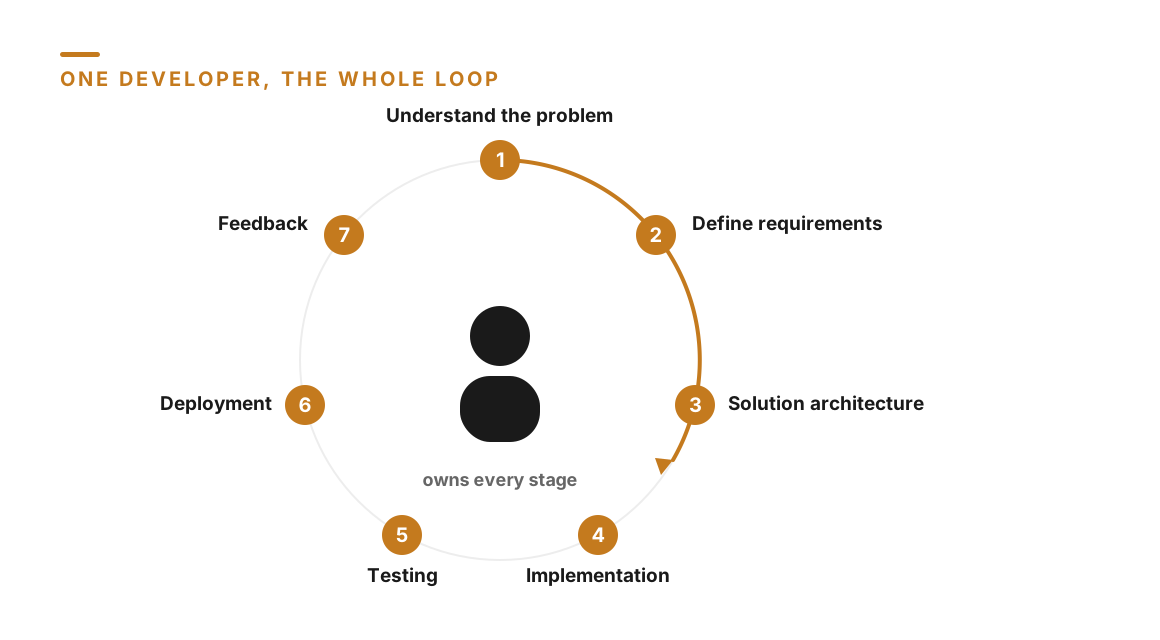
That's the part AI can't take, and it's the part the old specialist never had to do. The model will write a function. It will not figure out what you should have asked for in the first place, or notice that the requirement itself is wrong, or decide the whole feature is a bad idea. Someone has to own that, and increasingly that someone has to own all of it, because the handoffs between five narrow specialists are where the time and the meaning leak out.
AI didn't make developers less valuable. It moved where the value sits. It dropped from typing the code up to deciding what's worth building and whether what got built is actually right. A broad developer lives at that higher altitude. A narrow one is now competing with a tool that's faster than them at the one thing they do.
The thing I got wrong: you can't train your way there
My first instinct was the obvious one. If we need 300 people to level up, build a curriculum. Courses, learning paths, certifications, internal workshops. Pour it in at the top and let it flow down.
It mostly doesn't stick.
You can teach someone the syntax of a new framework in a course. You cannot teach judgment, architecture sense, or how to interrogate a vague requirement by putting them in a room with slides. Those only develop on real work, where there's a real consequence to getting it wrong and a more senior person sitting close enough to catch it.
We learned to stop treating upskilling like content to be delivered and start treating it like an apprenticeship. The actual unit of learning is a developer working on something slightly past their current level, with a senior engineer reviewing the work and explaining the why behind the feedback. That doesn't scale the way a video course scales. It scales the way mentorship scales, one relationship at a time, which is slower and more expensive and the only thing that has actually worked for us.
Training is an event. Upskilling is a thousand code reviews.
This is also where AI helps in a way people miss. Used well, it's a tutor that's always on. A developer pushing into unfamiliar territory can use it to understand a pattern, draft a first attempt, and ask the dumb questions they'd never burn a senior engineer's time on. It raises the floor on the routine stuff so the expensive human mentorship gets spent on the judgment that actually needs a human.
It only works if you hired learners
Here's the harder truth, and it's not a comfortable one for the "anyone can learn anything" crowd.
You can't upskill someone into a broad, AI-era developer if they don't want to be one. Plenty of engineers were happy being the specialist. They liked owning their corner and being handed clean tickets, and they have no interest in talking to a customer or owning a deploy. No amount of mentorship turns that person into the other kind.
So the real upskilling decision gets made at the door, before anyone is hired.
We accept fewer than 3% of the people who apply to Full Scale, and a long time ago we changed what we screen for. We stopped testing whether someone can recite syntax and started testing how they think, how they break down a problem, and whether they're actually curious. We're not hiring for what they know today, because what they know today is depreciating fast. We're hiring for whether they can keep learning, because the half-life of any specific skill keeps getting shorter.
When you start with people who are wired to learn, upskilling is just giving them harder problems and good feedback. When you don't, no curriculum on earth fixes it.
Why this is worth the cost
It would be cheaper to keep everyone narrow and just buy more AI seats. I think that's a trap.
A team of narrow specialists plus AI is still a team that needs someone to own every problem, stitch every handoff, and decide whether the confident output is right or fast garbage. AI makes that coordinator role more important, not less, and it makes the gap between a team that has broad owners and one that doesn't widen fast.
The engineers who own the whole loop are the ones who get more leverage out of AI, not less, because they have the judgment to direct it and catch it when it's wrong. That's the same judgment that takes months on a real product to build, and it's the knowledge that walks out the door when you treat people as interchangeable headcount. It's also why we put real money into growing people instead of churning through them, and why our developer retention sits at 93%. You don't get to compound someone's judgment if they leave every eighteen months.
Upskilling developers in the AI era isn't a training budget line. It's a hiring filter, an apprenticeship model, and a long bet on the people who want to own the whole thing.
The specialists AI replaces were never the ceiling of what a developer could be. They were just the version the old workflow rewarded. The new one rewards people who own the entire problem, and those are the people worth building a team around.