Employee retention is a silent killer for dev teams and AI is making it worse.
Teams track velocity, headcount, and tooling spend down to the decimal, and then lose the one person who knew how any of it worked.
Let's start with the numbers, because they're uglier than most people expect.
Software engineering is one of the highest-turnover jobs there is. Depending on whose survey you read, US tech attrition runs somewhere in the low double digits to the mid-20s percent a year.
Either way, a team re-hires a real chunk of itself every year just to keep up. And the replacement math is rough. We've all paid a recruiter $25,000 a pop to backfill someone who left, then waited three months for the new hire to start, only to do it all over again a year later.
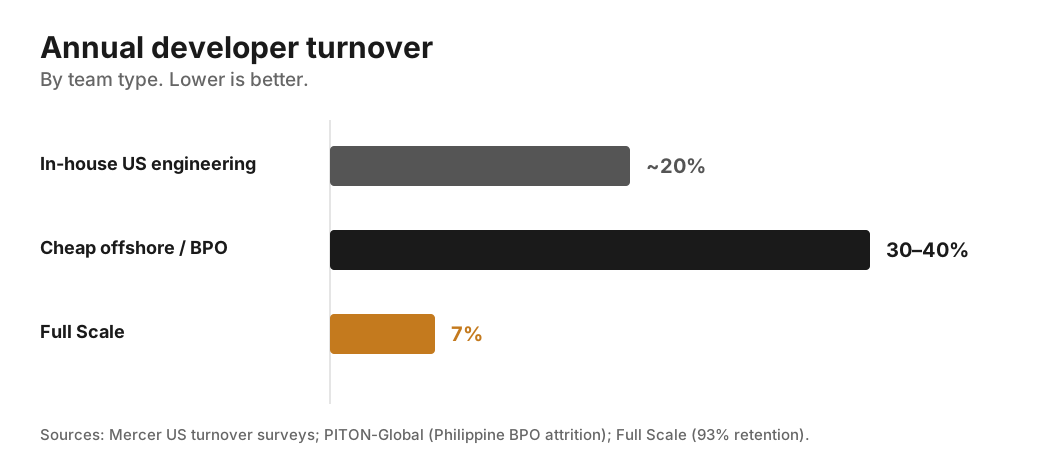
Distance makes all of it harder. A remote employee is easier to lose than someone you see every day, wherever they live, because it's harder to feel like you belong to a team you've never actually sat with. Take that team to the other side of the world and pick them on price, and you get the extreme version. The business process outsourcing (BPO) industry in the Philippines, the giant call-center and back-office world, runs annual attrition of 30 to 40%. Plenty of the cheap offshore dev shops look the same. People leave for an extra dollar an hour because they have no real loyalty to the client they work for.
Turnover is the number one problem in engineering right now, and the more distributed your team, the harder it is to solve.
Turnover is the tax nobody puts in the budget
When a developer quits, the cost doesn't show up as a line item. That's why it gets ignored. But it's real, and it's a lot bigger than the recruiter fee (which is also not in the budget) and the empty seat.
The real cost is the knowledge that walks out with them.
They knew why the billing service was built that strange way, and they could find a bug in it in twenty minutes because they wrote the thing. They were also the only one who still remembered the promise you made to a customer two years ago. That knowledge took months to build and you can't hire it back. You start over with someone new who needs half a year just to get to where the last person already was.
Every resignation quietly resets that clock to zero.
This isn't a human resources problem off in some other department. It's the thing quietly setting fire to your roadmap. You think you're behind because the work is hard. A lot of the time you're behind because you keep rebuilding the same team.
AI made that knowledge worth more, not less
You'd think AI would soften this. The new hire leans on Copilot, ships code on the first day, and catches up faster. But the coding was never the hardest part.
AI will write the code now. What it can't do is replace the judgment your old employee earned from working on this product for months or years.
It can't tell you why the billing system has that one strange exception, what you promised the customer who threatened to walk last spring, or which corner of the codebase you can't touch without taking down checkout. That's domain knowledge and tribal knowledge, the stuff that lives in your team's heads and almost never in the docs. It's the context that decides whether the code AI writes is the right code or fast, confident garbage.
AI didn't lower the cost of turnover.
It raised it.
The execution it automates is the cheap part. The part it can't touch, knowing what to build and why it matters, is exactly what leaves when a developer quits. A new hire with every AI tool on earth still doesn't know your business. They'll generate code all day and build the wrong thing fast.
There's a flip side. Our best hope is that over time AI holds onto more of this lost knowledge for us, captured in the documentation you probably don't write. The more a team puts its context into real docs and into the codebase itself, the more of it survives a resignation, and now that writing feeds both the next engineer and the LLM they lean on. It won't bring back the judgment that left with the person. But it's the closest thing we have to keeping it.
The teams winning with AI right now aren't the ones with the best tools. They're the ones who kept the people who understand the problem, and wrote down what those people know.
The model fails, not the country
I've hired developers in four countries and built an offshore team from scratch. The ones that stuck never stuck because of the rate. This is where most people draw the wrong conclusion: they decide offshore doesn't work, when what didn't work was the way they built it.
I have a name for the most common version. I call it cheapshoring: picking a partner on price and nothing else. When price is the only thing you care about, it's the only thing your partner cares about too. Their engineers are a cost to be squeezed, so they get paid the minimum, and get treated like interchangeable headcount. Then the client swears off offshore for good and blames the whole idea.
It was never the idea that was broken. It was the bargain-bin version of it.
You didn't actually grow your team if you didn't treat them like your team.
There are smart people all over the world. What decides whether a remote team sticks, offshore or just down the road, isn't talent, and it isn't the time zone. It's communication, and whether those people are actually on your team or walled off behind someone.
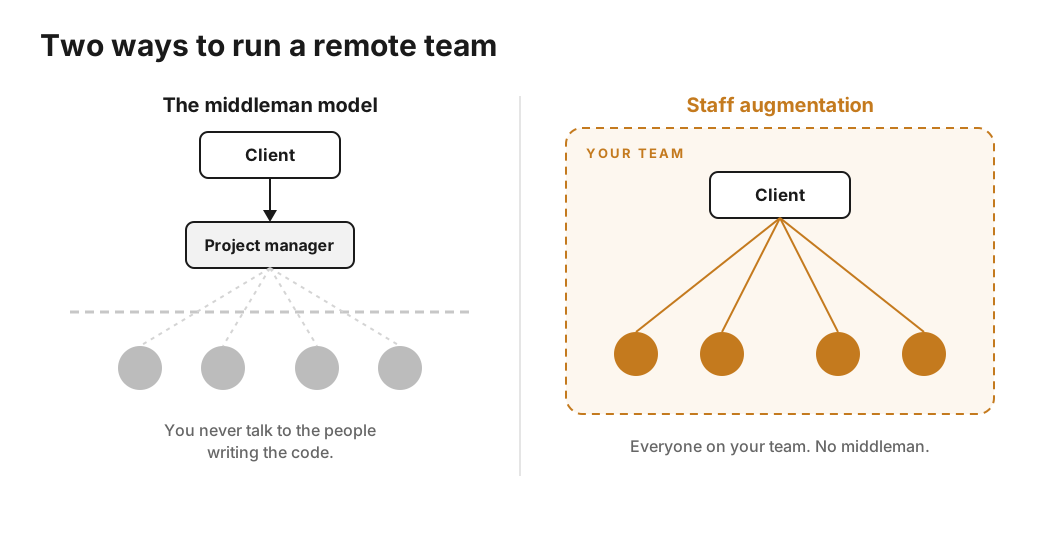
I've talked to founders running teams overseas who have only ever spoken to one person, a technical project manager. Every other developer hides behind that guy. The client never builds a real relationship with the people writing the code, and there's a middleman in the way of every decision. Nobody on a team like that is attached to anything. They're order-takers on someone else's project, so of course they don't stay around.
Staff augmentation is the right way. You hire people to work directly for you, on your team, for the long haul, the same way you'd hire someone down the hall. No middleman fronting the team. They're in your standups, they see the roadmap, they hear what the customer actually needs, and they own a piece of it.
The best version of this I can point to is AMC Theatres. The developers we placed in the Philippines are treated as full AMC engineers, not as a contractor block sitting outside the org. They're on the same Slack, in the same code reviews, and held to the same standards as the Kansas City team. The AMC folks even fly out to the Philippines. There's karaoke, dinners and actual friendships. Those engineers care about the product the same way the in-house ones do.
That is what makes offshore actually work. (I wrote up the longer playbook on what keeps engineers around here.)
This is what builds real loyalty, and it's how you grow a team instead of just renting one.
You can't retain your way out of a bad hire
The other half of retention happens before anyone is hired at all.
A wrong hire leaves no matter how well you treat them, either because they were never a fit or because they were never that into it to begin with. That's why the work starts at the door. We accept fewer than 3% of the people who apply to Full Scale, and we changed how we interview a long time ago to focus on how someone thinks, their problem solving and product sense, instead of whether they can recite syntax on command. The engineers who stay and do great work are the ones who care about the product and will speak up when something's wrong.
You're not just screening for skill. You're screening for the kind of person who wants to stick around and own something.
Hire for that and retention gets a lot easier. Skip it and no amount of perks will save you.
What 93% actually takes
Here's how I know this is the thing that matters most: it's the first thing new clients bring up.
When our sales team gets on a call with a company that already has an offshore vendor, employee turnover is one of the top reasons they want to switch. Their current team churns every few months, they're forever re-explaining the product to someone new, and they've had enough of it. We honestly didn't realize it was such a big issue until we kept hearing the same frustration over and over.
Our developer retention at Full Scale is 93%. Compare that against the 60 to 70% of the BPO industry and the gap is the whole story. We lose about seven people out of a hundred a year where others lose a third or more.
It isn't a trick, and it isn't because Filipinos are magically loyal. It's a stack of boring choices, and none of them are exotic. We pay at the top of the local market instead of the bottom. We put real money into training and mentoring so people grow instead of stall. We give every team someone whose actual job is catching problems while they're still small. And we treat the team like our own people, not a line item, which is why 95% of them say it's a great place to work versus 65% at a typical company. Any leader could make these same choices. Most don't.
Clients feel it most in the thing they never have to think about. Dustin Johnson, Co-Founder and CTO of SOTA Cloud, put it plainly: "We really highly value retention, and so Full Scale has been a great partner on the retention front to ensure that we have continuity with the folks that we really value on our team."
Continuity is the whole point. The team that learns your product this year is the team that's still building it next year.
You can hire a developer almost anywhere now. Keeping them is the part that decides whether any of it actually works.