
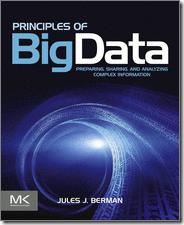
A fantastic book! Must be part, if not yet, of the fundamentals of the Big Data as a field of science.
Highly recommend to those who are into the Big Data practice.
Yet, I confess this book is one of my best reads this year and for a number of reasons:
The book is full of wisdom, intimate insight, historical facts and real life examples to how Big Data projects get conceived, operate and sadly, yes, sometimes die.
But not only that, the book is most importantly is filled with valuable advice, accurate and even overwhelming amount of reference (from the positive side), and the author does not event stop there:
there are numerous technical excerpts, links and examples allowing to quickly accomplish many daunting tasks or make you aware of what one needs to perform as a data practitioner (excuse my use of the word practitioner, I just did not find a better substitute to it to trying to reference all who face Big Data).
Be aware that Jules Berman’s background is in medicine, naturally, this book discusses this subject a lot as it is very dear to the author’s heart I believe, this does not make this book any less significant however, quite the opposite, I trust if there is an area in science or practice where the biggest benefits can be ripped from Big Data projects it is indeed the medical science, let’s make Cancer history!
On a personal note, for me as a database, BI professional it has helped to understand better the motives behind Big Data initiatives, their underwater rivers and high altitude winds that divert or propel them forward.
Additionally, I was impressed by the depth and number of mining algorithms covered in it. I must tell this made me very curious and tempting to find out more about these indispensable attributes of Big Data so sure I will be trying stretching my wallet to acquire several books that go more in depth on several most popular of them.
My favorite parts of the book, well, all of them actually, but especially chapter 9: Analysis, it is just very close to my heart. But the real reason is it let me see what I do with data from a different angle. And then the next - “Special Considerations”, they are just two logical parts.
The writing language is of this book is very acceptable for all levels, I had no technical problem reading it in ebook format on my 8” tablet or a large screen monitor.
If I would be asked to say at least something negative I have to state I had a feeling initially that the book’s first part reads like an academic material relaxing the reader as the book progresses forward.
I admit I am impressed with Jules’ abilities to use several programming languages and OSS tools, bravo! And I agree, it is not too, too hard to grasp at least the principals of a modern programming language, which seems becomes a defacto knowledge standard item for any modern human being.
So grab a copy of this book, read it end to end and make yourself shielded from making mistakes at any stage of your Big Data initiative, by the way this book also helps build better future Big Data projects.
Disclaimer: I received a free electronic copy of this book as part of the O'Reilly Blogger Program.