

Handing off tickets doesn’t buy you a good night’s sleep.
I learned this the hard way: 2 a.m., phone buzzing, production fire.
“I thought Bryan owned that…”
I’d delegated, but the work still boomeranged back to me.
That’s the Invisible Ownership Trap—when responsibility changes hands on paper, but the real weight never leaves your shoulders. If ownership isn’t visible, it isn’t real – and your team feels the pressure without the power.
Real delegation isn’t a checklist item.
It’s a system you design on purpose.
After working with dozens of CTOs at Full Scale, (and cleaning up my own late-night messes), I’ve boiled that system down to five non-negotiable hurdles. Clear them, and you can finally log off without checking Slack “just in case.”
1. Define the Edges
“What am I actually allowed to decide?” is the first question every engineer asks—usually silently.
Spell out what’s locked, what’s flexible, and when they should pull you back in. Clear edges don’t restrict ownership; they enable it.
2. Provide Context, Not Control
Dumping tasks is offloading. Real delegation shares the why.
Describe the problem, the stakes, success metrics, and lurking risks. When people understand purpose, they won’t get stuck on process .
3. Make Ownership Visible
If the org can’t point to a name, no one truly owns it.
Announce the owner aloud, put it in the plan, and make it obvious across teams. Visibility builds confidence and signals belief.
4. Support Without Hovering
Delegation isn’t disappearing. It’s staying just close enough to coach.
Swap answers for questions: What are you optimizing for? What feels stuck? Trust—but verify—without micromanaging.
5. Follow Through, Not Just Follow Up
Ownership doesn’t end when the code ships. It ends when the problem is solved and the learning is shared.
Debrief every launch. What surprised us? What worked? What will we carry forward? That’s “trust but verify” in practice.
Why These Hurdles Matter
When you clear all five, you unlock the ownership flywheel:
Trust → Ownership → Impact → More Trust
Your team stops waiting for permission. They start making better decisions. And you—finally—stop being the bottleneck.
Try This Tomorrow
-
Pick one project and write down its edges and success measures in a single paragraph.
-
Name the owner in public—stand-up, Slack, roadmap doc.
-
Schedule a 15-minute post-launch retro before work even starts.
Do that, and you’re already halfway over the first hurdle.
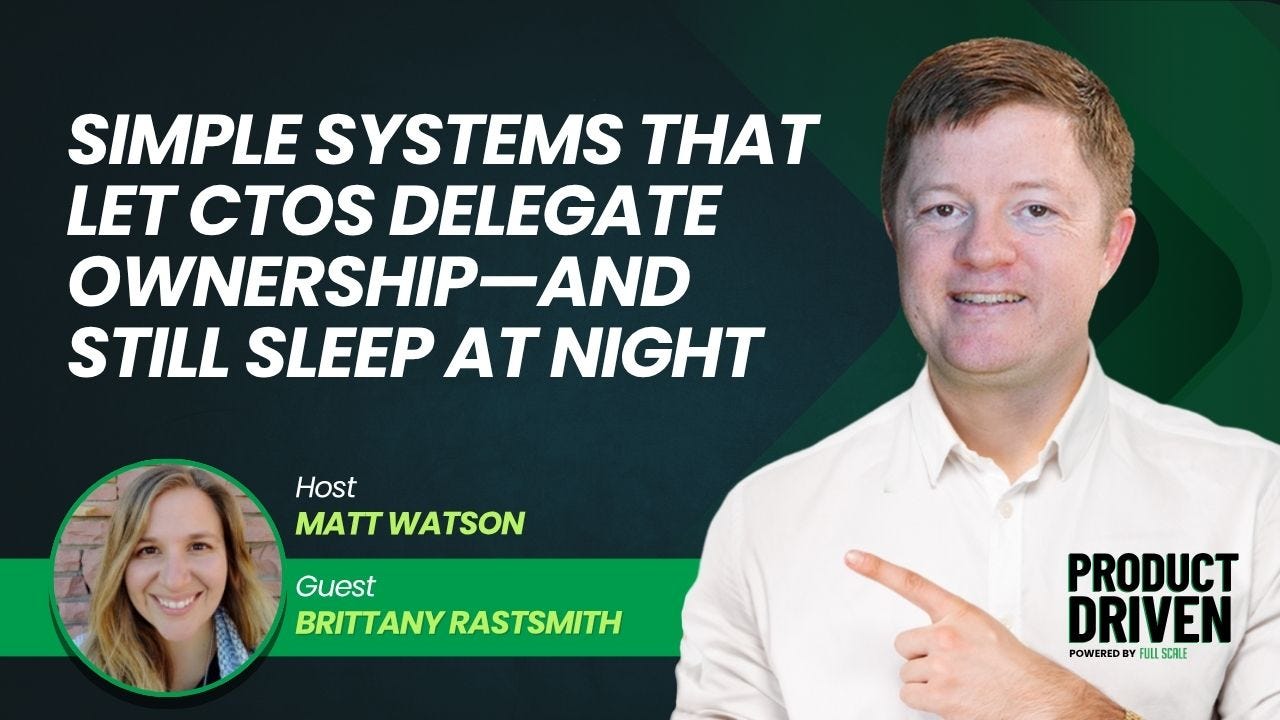
In this week’s podcast episode, I sat down with engineering leader Brittany Rastsmith to dissect real-world examples of each hurdle in action—plus the subtle signals that tell you delegation is slipping back onto your plate. If you’ve ever woken up to those 2 a.m. alerts, this conversation is your blueprint for sleeping through the night.
Listen here → “Systems that Let CTOs Delegate Ownership—and Still Sleep at Night”