
Just after finishing my multicolor RGB controller shield for Arduino, I came across Fritzing, a program that lets you convert your breadboard prototypes into a physical PCB. Since I got one design working at hand, I decided to give it a try. The process is very straightforward.
First you simply put all the components in the breadboard view. The parts library contains most common parts, and you use wires to connect them – exactly the same as you would do on your physical prototype:
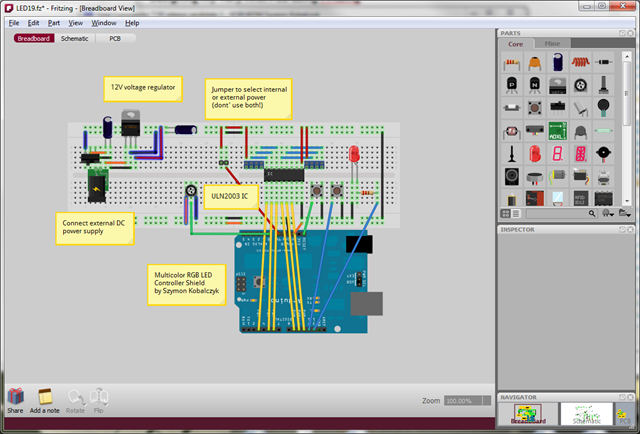 Next you can switch to schematic view where you can check if all the connections are correct:
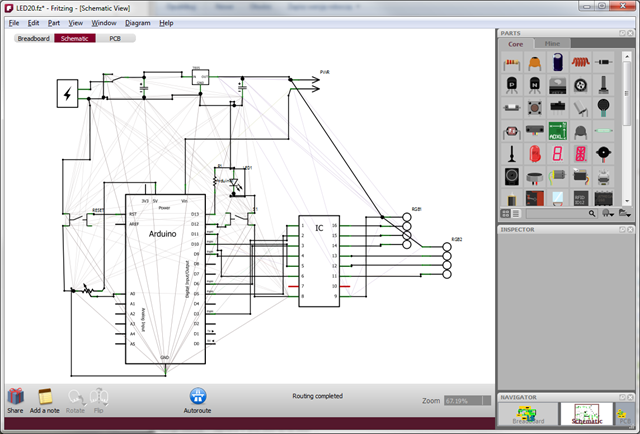 Finally you go to the PCB view and layout your parts on the board. Then you need to route all traces, and while Fritzing does quite a good job with auto-routing, it is worth to spend some time and review the design. In my case I was able to eliminate all the jumper wires – needed otherwise because currently Fritzing supports only single-sided PCBs.
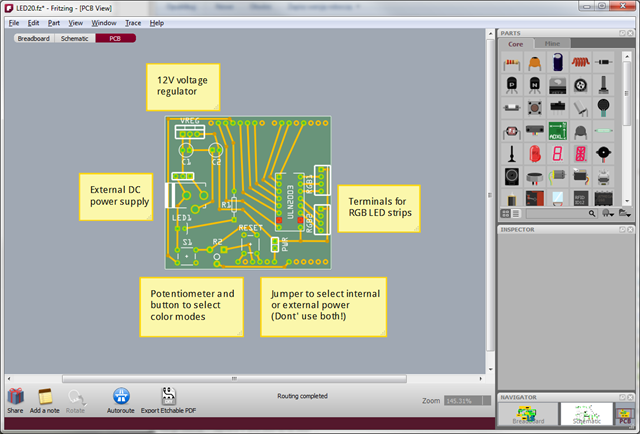 In my case I designed the board to fit as an Arduino shield. As you can see it consists of a 12V voltage regulator circuit for external power source and ULN2003 converter to drive two RGB outputs.
After you are happy with you can save it in multiple output formats. For me the the etchable PDF format was especially handy because I could print it as a paper prototype and check if all the physical parts will fit properly.
Fritzing also offers a website where you can upload your projects along with any additional documentation, images, and source code. You can find my project page here: http://fritzing.org/projects/multicolor-rgb-led-controller-shield-for-arduino/
On top of that, starting with January 2010 they start a Fritzing Fab Service, and produce the real, physical PCBs. In preparation for this, they selected 24 projects and made them manufactured. I was very happy that my design was selected as one of these projects.
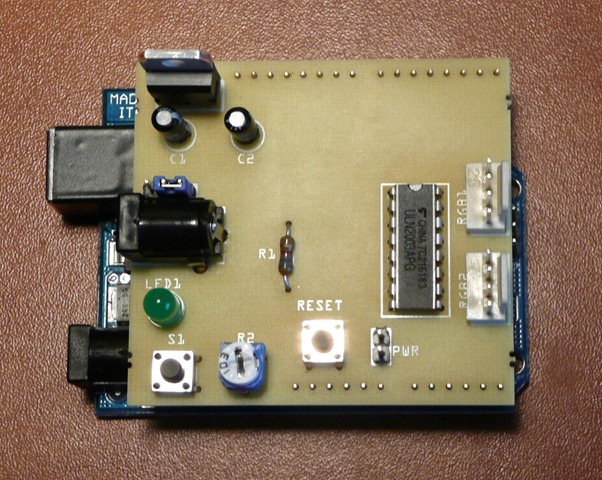
I got my board short after Christmas, and it looks very professional (at least for me:-)):
!(/images/kobush/137328/3c2b4c84-fritzing.jpg)
And here is the final product:
As a geek I always wanted to hack the hardware like this, but at the same time I was intimidated by my little knowledge of electronics. So its truly amazing how much can be done with such simple tools, and how much I learned in past half a year since my good friend Marcin Ksiazek introduced me to Arduino. For me it’s just the essence of the Arduino phenomen – perfect combination of open source hardware, software and the community.
On the side note, I’m bit upset that the same didn’t happened with the.NET Micro Framework, because I think on the software side it has even greater potential (like you can write and debug your code in Visual Studio you know and love). And although I think making the platform open source is a great move, the hardware costs are the biggest barrier right now. Especially if you consider using it for few hobby projects (I don’t know what’s the pricing looks like for mass production).
I will be exploring.NET Micro Framework shortly so stay tuned.