This blog has personalition features for you, the reader. Below is a key of what all the icons mean and which aspects of the layout they change.
Close Window
This is part 3 of 3
Tuesday, February 17, 2009 3:19 PM
We simply isolate old technology in virtual machines that very rarely have os/other patches applied to them. This preserves the application's best known working environment. We use that cost reduction to help fund replacement of older technology such as VB6. Our shop is fortunate in that we did not buy heavily into third party VB6/com based addin GUI widgits as well as did our large tasks in SQL Server stored procedures instead of queries embedded in VB6 code. We also avoided overly complicated classic ASP/asp1.x applications
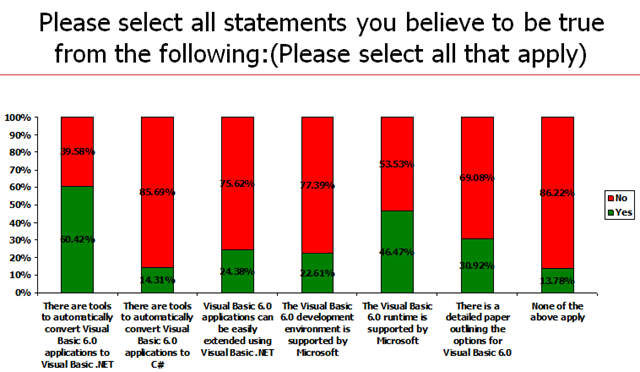
I beliieve that I am right in saying that the VB6 runtime is still technically supported within Windows XP, Windows Vista and Windows Server 2003, and possibly Server 2008 though I may be totally wrong on that one. Whilst this support period will come to an end within these operating systems, I guess it is unlikely that Microsoft is suddenly going to do something to prevent the runtime working within one of these currently supported Operating systems. I am aware that the development environment is no longer supported.I would be interested to know to what extent the vb 6 runtime (if at all) will exist in Windows 7. I would guess that it is probably too early to remove it totally, but if it is there, to what extent will its functionality be supported? presumabely it will just be on the basis that most things will work but if you find stuff that doesn't you'll be on your own. What is the official line from Microsoft on this?
It would be interesting to ask the cost impact of trying to convert users vb6 codebases to vb.net, especially with that next to useless import wizard?<rant>I utterly abominate that piece of junk - the hours/days of needless pain that it inflicts!</rant>
Fields denoted with a "*" are required.
Subscribe in a reader